How Do You Specify Grout and Adhesive for Large Format Tile?
 Nicole Bickley
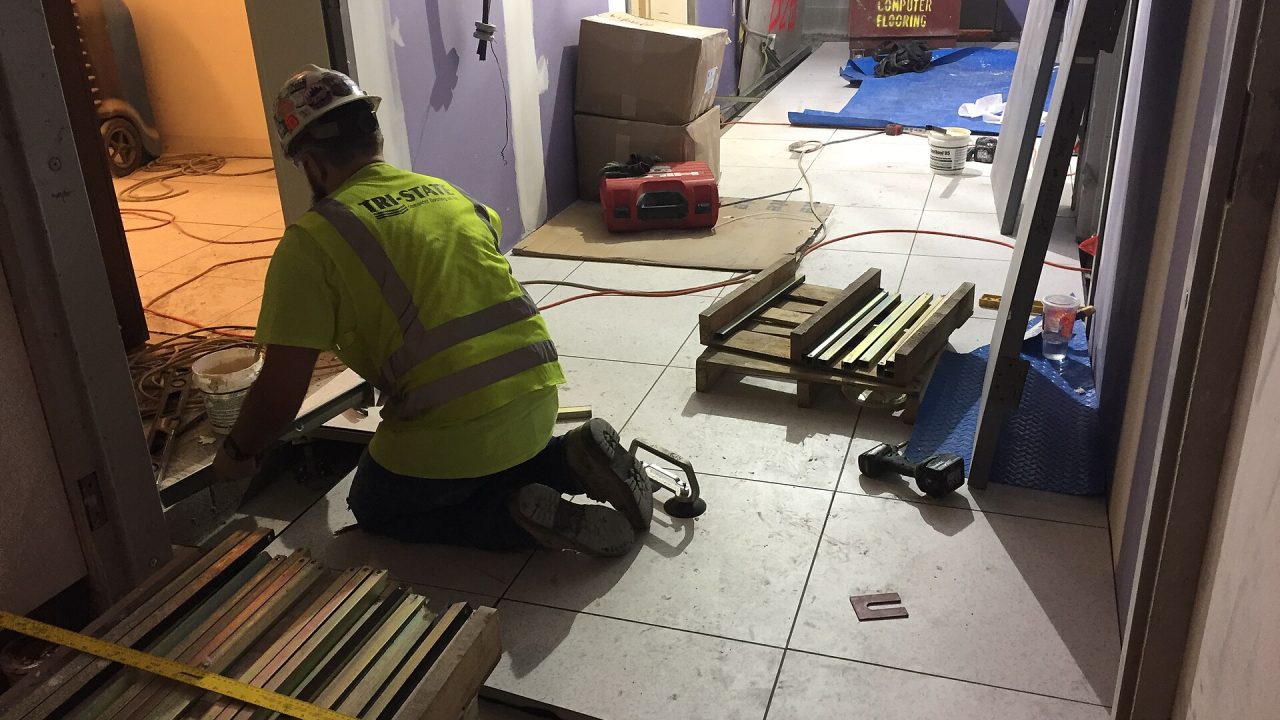
Large format tile needs a cement-based, flexible, large-and-heavy-tile adhesive applied as a full bed with a 10mm notched trowel plus back-buttering, and a flexible grout with a movement joint at every perimeter and every six metres internally. Standard adhesive and standard grout will fail, usually within two heating cycles.
The specification has three parts that must match: tile weight and format, substrate movement, and the service conditions. Miss any one and the failure appears as hollow tiles or cracked grout within a year.
What counts as large format tile?
Anything over 600mm in either dimension, and anything over 15mm thick. Above 1,200mm the tile is usually classified as slab and needs different handling equipment.
Weight is the number that matters for the substrate. A 1,200 by 600 porcelain tile at 10mm is around 25 kilograms per square metre.
What adhesive class should be specified?
C2TE in the European classification: cement-based, improved adhesion, reduced slip, extended open time. For very large tile, a C2TES1 with added deformability.
The letters matter. C1 is standard and unsuitable; C2 is improved; S1 denotes deformability, which is what absorbs substrate movement.
How thick should the adhesive bed be?
3mm minimum after the tile is pressed, achieved with a 10mm notched trowel plus back-buttering to 80 percent coverage. In a wet area, aim for 95 percent.
Coverage is measured by lifting a tile after laying. Voids are where water sits and where tile cracks.
Does back-buttering matter?
Yes, on any tile over 600mm and on any tile with a deep profile. Back-buttering fills the recesses that a notched bed cannot reach.
It also improves the bond on the tile side, which is the side that fails first on a dense porcelain.
What grout should be used?
Flexible cementitious grout, class CG2 WA where the classification applies, with a joint width of at least 3mm. Epoxy grout where chemical resistance or hygiene is the priority.
Standard grout in a 1mm joint on a large tile has nowhere to move. It cracks along the joint line within months.
How wide should the joints be?
3mm minimum for rectified tile, 4 to 5mm for non-rectified, and wider where the substrate is not flat. A 1mm joint looks precise and performs badly.
The joint is the movement accommodation. Making it narrower removes the only flexibility in the assembly.
Where do movement joints go?
At every perimeter, at every change of substrate, at every internal corner, and at intervals of six metres internally and three metres externally. In a wet room, also at the wall-floor junction.
These are not optional. A floor without movement joints will create its own, usually through a tile.
How is the substrate prepared?
Flat within 3mm over two metres, primed, and free of dust. Large tile cannot bridge a substrate that is out of flat, because the tile itself will not bend.
Levelling compound is the normal answer. It is cheaper than the extra adhesive needed to bed an uneven floor.
Can large format tile be laid on a wall?
Yes, with a suitable backer board, mechanical support during curing, and often a tile levelling system. Adhesive alone will not hold a 25 kilogram tile while it sets.
Check the board’s weight rating. Many are rated at 30 to 40 kilograms per square metre, which is close to the limit.
What about cutting and drilling?
Use a wet saw with a continuous rim blade for straight cuts, and a diamond core for outlets. Plunge cuts with an angle grinder cause chipping on the visible edge.
Cut edges need a trim or a mitre. A raw edge on porcelain is sharp and porous.
How much does a proper specification cost?
Adhesive and grout for large format work runs 8 to 20 per square metre, roughly double a standard installation. Levelling clips add 2 to 4.
The labour is the bigger change, often 30 to 50 percent higher than standard tile because of the handling and the flatness requirement.
Why do large tiles crack?
Three reasons: voids in the adhesive bed, no movement joints, and a substrate that deflects. All three are installation or specification errors, not product faults.
The crack usually starts at a corner or along a joint, and it travels because the stress has nowhere else to go.
Can large tile go over underfloor heating?
Yes, with a flexible adhesive, a decoupling membrane and a slow commissioning schedule. The heating must be brought up to temperature gradually over seven days.
Switching a heated floor on at full output a week after tiling is the fastest way to crack a large tile installation.
What grout colour should be specified?
A mid-tone that matches the tile, in a wider joint. White grout on a floor shows every mark; black grout shows every efflorescence bloom.
Grout is the most visible part of the job and the first to fail if the wrong class is used.
How is the installation checked?
Tap every tile after 48 hours; a hollow sound means a void. Check joints for width consistency, and check the perimeter for a movement joint.
Lift one tile in an inconspicuous area to inspect coverage. It is destructive, and it is the only direct evidence of the bed.
What is the most common specification omission?
The movement joint. It is left out because it interrupts the visual line, and its absence is the direct cause of most cracked tile floors.
A colour-matched sealant in the joint reads as a grout line and performs as a joint. There is no reason to omit it.
Does the tile format affect the substrate choice?
Yes. Above 1,200mm, the substrate has to be especially rigid, and on walls a mechanical fixing scheme may be required in addition to adhesive.
The specification has to be read as a system: tile, adhesive, substrate, movement joints. One weak link decides the outcome.
Can large format tile be used on a staircase?
Only with a continuous substrate and a very careful set-out, because every step is a different cut and the edges are exposed. Most staircases are better served by a smaller format.
Where large tile is used, the nosing needs a profile rather than a raw edge. A raw porcelain edge on a stair is both sharp and fragile.
What should be in the written specification?
Adhesive class, trowel size, coverage minimum, grout class and joint width, movement joint positions, substrate flatness tolerance and curing times. Six lines that decide whether the floor lasts.
Put them in the contract, not in a conversation. A verbal specification is not a specification. The guide on tile substrates for a wet room covers the layer below.
Tile failures are almost always specification failures rather than product failures, which makes them preventable on paper. The guides on wet room substrates and on movement joints cover the adjoining decisions.
Related guides
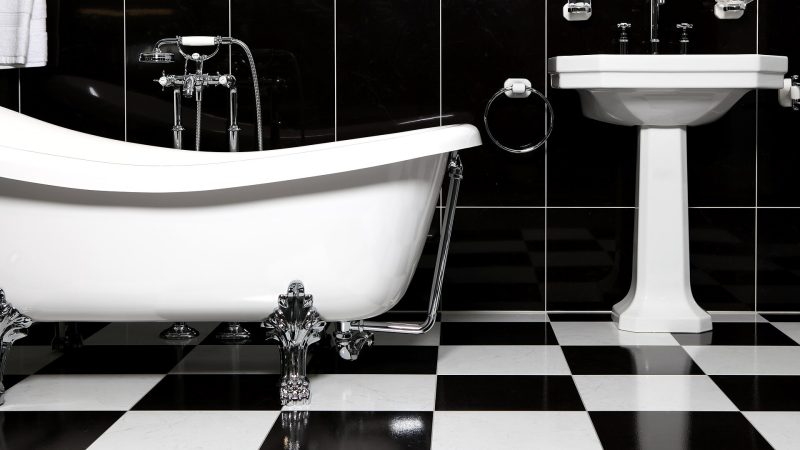
Why Do Movement Joints Matter in a Tile Installation?
Because tile, adhesive and substrate all move at different rates, and a movement joint is the only place…
Nicole Bickley
How Much Expansion Gap Should You Leave on a Timber Floor?
Leave a 10mm expansion gap at every wall and fixed obstruction for a domestic room up to six…
Nicole Bickley
What Paint Finish Should You Use in a Bathroom?
Use a water-based eggshell or satin with a fungicidal additive on walls, a moisture-resistant ceiling paint with the…
Nicole Bickley